
Friday, November 17, 2017


Halloween Special 2017
This is possibly the loveliest thing I have ever made, although from the low number of views it is also possibly the most invisible thing I have ever made. Please watch it, and show it to someone else.
Published on Oct 26, 2017
To those who celebrate, best wishes for a happy new year. And to all, Happy Happy Happy Halloween!
Music: “We Are the Flow,” Lila, https://www.lilagoddess.com/
Published on Oct 26, 2017
To those who celebrate, best wishes for a happy new year. And to all, Happy Happy Happy Halloween!
Music: “We Are the Flow,” Lila, https://www.lilagoddess.com/
"Tagelied," Faun
For years, I have been intending to do something with the lovely piece of music "Tagelied" by Faun. Fearing that someday would never come, I just decided to wing it in this improvised clip.
Happy Equinox!
The sound starts a few seconds in to this video, and hearing it is important to your enjoyment of this masterwork. So before you hit play, turn the sound up or make sure that it is on. Okay, proceed.
Created October 2017. Shout out to celebrity DP my mom.
Short Attention Span Living Room Theater, episode 2
Music: Melody of Love, Mohamed Fawzy. Filmed October 3, 2017.
Short Attention Span Living Room Theater, episode 1
Music is Zanooba, Mohamed Fawzy. Recorded September 28, 2017
Monday, January 11, 2016
From November
Filmed November 19, 2015, at KGB's Red Room Lounge, NYC.
New album "Sketches of Spam" available at http://www.cdbaby.com/cd/spaghettieas...
Time Out New York says: "Cataldi's largely instrumental, Eastern-influenced jams are infused with some delicate guitar work and hauntingly moody atmosphere." Newsday adds: “Mad scientist-guitarist-keyboardist Cataldi has unleashed another project on an unsuspecting world which brings the funk and throws it in a mixer with electronica, bebop and blues.” Called "a stimulating soloist" by the The NY Press, "triumphantly funkified" by UPI, "a jazz virtuoso without the need to prove it" by Aquarium Weekly.
More sounds at
www.soundcloud.com/spaghetti-eastern-mus
www.reverbnation.com/spaghettieasternmus
@ Sal Cataldi/Gravi-N-Bizqits Music (ASCAP) 2015
Thank you to photographer JR Rost:


Tuesday, January 5, 2016


Sunday, December 20, 2015
I Know You Will
Filmed October 25, 2015, at Triskelion's new theater in Greenpoint, Brooklyn. Thank you to videographer Renée Renata Bergan. This piece was commissioned by/ presented as part of "She: Voices of Women, Heard and Unheard,"
a theatrical work from Dalia Carella and the Dalia Carella Dance Collective. The music is "Young and Beautiful," Lana Del Rey.
I have no idea what this dance objectively looks like. I don't know if it's a work in progress or if its done or if it's going to be stuffed in a closet never to be seen again. This is my second attempt at a genre I guess I am calling "postbellydance bellydance." (I know this very phrase is going to make someone out there squawk, "that's not belly dance!" Obviously, it is not Oriental dance, it is not raks sharki, it is not Middle Eastern dance. But I think it kind of is belly dance, in the sense that "belly dance" is an umbrella term, because you are not going to find anyone else to claim it. If you ask anyone in the modern dance world no way will they see anything even vaguely of their own idiom in this piece.) Putting this thing together was absurdly hard, because I had no template to work from: no set pool of vocabulary, no conventions of sequencing or interpretation; no constraints of style; no proven successes to imitate. I am not sure where, if anywhere, this piece can goes from here; finding another venue for it seems unlikely. Anyway, inasmuch as it works or doesn't work, please multiply your praise or qualify your criticism relative to the fact that I am really out on my own, finding my own way here.
A technical note: I have nothing but gratitude for remastered music, but your enjoyment of this piece might be slightly heightened by the floor-thumping slap-whacks one would hear were one in the actual live audience. Be advised: rich, bassy, dull, sharp, and otherwise eminently satisfying whomps occurred at 1:18, 2:17, and 3:02. I really hurled my soft, tender, bruisable body into this real-time Foley, so please manifest appropriate sound effects in your imagination.
Also: in meatspace, there was glitter, there were sequins, and I sparkled. At least, I think I sparkled. I am not sparkling in this video, but I think there was real life sparkle.
Moving on. When I started working on this dance, I was in the seventh year of a continually difficult romantic relationship. I went into this project thinking that I was working on an autobiographical and bittersweet piece about anxiety and fragility and the mature adult fears of my mature adult self. In my head, I heard the song as “Will you still love me? I know you won't, I know you won't, I know you won't.” I know you don't.
I have no idea what this dance objectively looks like. I don't know if it's a work in progress or if its done or if it's going to be stuffed in a closet never to be seen again. This is my second attempt at a genre I guess I am calling "postbellydance bellydance." (I know this very phrase is going to make someone out there squawk, "that's not belly dance!" Obviously, it is not Oriental dance, it is not raks sharki, it is not Middle Eastern dance. But I think it kind of is belly dance, in the sense that "belly dance" is an umbrella term, because you are not going to find anyone else to claim it. If you ask anyone in the modern dance world no way will they see anything even vaguely of their own idiom in this piece.) Putting this thing together was absurdly hard, because I had no template to work from: no set pool of vocabulary, no conventions of sequencing or interpretation; no constraints of style; no proven successes to imitate. I am not sure where, if anywhere, this piece can goes from here; finding another venue for it seems unlikely. Anyway, inasmuch as it works or doesn't work, please multiply your praise or qualify your criticism relative to the fact that I am really out on my own, finding my own way here.
A technical note: I have nothing but gratitude for remastered music, but your enjoyment of this piece might be slightly heightened by the floor-thumping slap-whacks one would hear were one in the actual live audience. Be advised: rich, bassy, dull, sharp, and otherwise eminently satisfying whomps occurred at 1:18, 2:17, and 3:02. I really hurled my soft, tender, bruisable body into this real-time Foley, so please manifest appropriate sound effects in your imagination.
Also: in meatspace, there was glitter, there were sequins, and I sparkled. At least, I think I sparkled. I am not sparkling in this video, but I think there was real life sparkle.
Moving on. When I started working on this dance, I was in the seventh year of a continually difficult romantic relationship. I went into this project thinking that I was working on an autobiographical and bittersweet piece about anxiety and fragility and the mature adult fears of my mature adult self. In my head, I heard the song as “Will you still love me? I know you won't, I know you won't, I know you won't.” I know you don't.
By the time of the performance, that
relationship had ended. The breakup engendered, and continues to
engender, all kinds of anxiety and hurt and fear, and developing this
particular dance during a breakup was, at times, variously awkward
and painful. But then somewhere along the way I got sick of
unremitting lugubriousness. Likewise, I got sick of focusing on the
anxiety that provokes the question, “Will you still love me?” The
dance hauled itself out from under my agenda of resentment, the
despair and stagnation melted out, and I found that I was
unaccountably working on a piece about resilience, trust, love, and love's triumph over fear.
What this dance turned into feels very
much to me like a theatrical character piece. It's still personal,
but the aspects of myself that I feel coming through are remnants of
a younger woman. In character, I don't feel like my mature and
pragmatic 2015 self. I feel more 1995. I feel giddy, inexperienced,
bluntly imprecise, enthralled by the rush of riding a self-created
emotional roller coaster. I don't mean it in a judgmental way, but I
also feel foolish, although I feel a little more wise at the end.
I'm not sure if it's visible or not, but I feel like there's an arc,
about coming from childhood into the power of adult wisdom. The song
itself ends on the question, “Will you still love me?” But the
dance ends on a certainty: if your love for me is ephemeral or
uncertain, then I'm relieved to be rid of your company, and the
sooner the better. By the end of the song, both the character and I
have had it with worrying over this fundamentally preposterous
question. Will you still love me? OMG, [eyeroll] [whatevs] good
grief, give me a break.
I can't make my life be about running around in circles frantically chasing your approval. This is a fool's errand. Enough foolishness.
 |
| Will you still love me? Enough already! SAVE THE DRAMA FOR YOUR LLAMA. |
I can't make my life be about running around in circles frantically chasing your approval. This is a fool's errand. Enough foolishness.
Love melts fear. Fear whispers to me
that while men become more attractive mates as they grow older, women
simply grow old. All that waits for me, fear whispers, is loneliness
and loss. But when I shine out love, fear crumbles away.
So, back to the other certainty: I know
you will. Back to the breathless excitement, not of manufactured
drama, but of hot, passionate, romantic, true love. If my feet are in
the path of offsweeepedness, for heaven's sake I am not getting them
out of the way. Don't you get them out of the way either. Shine out
love, and fear crumbles away.
Wednesday, September 2, 2015
Saying Too Much, Too Little, and Just the Right Thing
A few days ago I published a very honest blog post about difficult emotions. If you didn't see it, the
quick summary is that I wrote about resilience and fragility, and
about disappointment over a specific performance that I perceived as
going badly. I also directed readers to a Kickstarter for an upcoming project in which I'll be participating. That project, SHE: Voices of Women, Heard and Unheard, has since reached its funding goal. Thank you.
Whether or not talking honestly about difficult emotions was a good idea, I am not totally sure, but on the balance it seems
to have made a good impression on people that count. It has also
made all kinds of other impressions, so I think I should say a little
more.
My experience of being in the world is
pretty challenging. Some of it relates to circumstances, and some of
it stems from choices I make with my eyes open. I'm not exactly
comfortable with risk, but I'm explicitly uncomfortable in the
shallow end of the pool. I get bored. To fit in, I try to act like I'm not bored, and then I feel fake. I like the deep
end better, even with all the flailing and struggling to stay afloat,
even though risk sometimes ends in failure, and even though failures
often hurt. I often hurt. But it's okay. I am by no means
anguished all the time, I just feel things deeply. There are plenty
of high points, and sometimes I think that the very depth of the
troughs makes the high of the highs even higher. And you know in the flimsy yoga class at the gym, the thing that the twenty year old
teacher endlessly babbles on about but doesn't understand, about
sitting with the discomfort? I'm good at that.
Other people, though, not so much,
which is why I keep a lot of things to myself. I know that
this has left many people at cocktail parties with the impression that I'm
sort of a bland person without much to say, but I don't like to be
dishonest or make smalltalk, and when I speak openly about my life,
it makes people uncomfortable. Everyone wants to help; everyone
wants everything to be okay. Thanks everyone. I want this too,
mostly, but not enough to resign myself to the monotony at the boring shallow end of the pool. And it's not just the difficulties. Sharing my pleasures is often similarly
unrewarding. For instance, there was that day when I came bounding
into work ecstatically gleeful about the flock of turkeys in the
parking lot, and then for weeks no one could shut up about how I love
turkeys, and, “So did you see your turkeys today? Do you miss your
turkeys? Are you gonna get your work done, or are you just thinking
about turkeys? I brought a turkey sandwich for lunch, are you gonna cry?
Is your boyfriend jealous about how much you love those turkeys?”
Good grief. Okay, I like turkeys. It was fun to see turkeys. I like creatures. Why don't you? What is
wrong with you people?
I know I weird people out sometimes.
Believe me, I got the message, you don't need to tell me, I'm acutely self-conscious about it. With regard to my last post, I know that, for some readers,
TMI is not just a nuclear plant in Middletown. I perhaps overshared, and maybe even appeared
distastefully narcissistic or exhibitionist. Some readers expressed
concerns that I might be going through something heavy, and went into
crisis-response mode. Even though these reactions were not entirely
unexpected, I still feel embarrassed.
(Thank you, by the way, to those that
checked in. I am not in any more of a crisis than the general
baseline of my life, this is just what the inside of my head always
looks like. Which, as previously mentioned, is okay. But I genuinely appreciate and admire your care and
thoughtfulness.)
I'm also self-conscious about anyone
I've disappointed. If you have been somehow influenced by my
artistic output and my expression of uncertainty in some way let you
down, I'm sorry. I believe strongly in the power of language to
program reality; people, including one's very suggestible own self,
by and large see what you tell them is there, so although I am not always successful I do my best to
follow the sales formula of relentless enthusiasm. And, careerism
aside, if someone says they liked your performance (or, for that
matter, your haircut, your suiseki display, the molded Jello Waldorf
salad you brought to the Junior League luncheon, whatever), no matter
if you've somehow come to disdain the thing in question, it is just
plain rude to answer a compliment with anything other than “thank
you.” It's important to me that I never insult the tastes of my
admirers. If someone likes something I did and they have been
gracious enough to go out of their way to tell me about it, in my
opinion the last thing they deserve is a reproach. They deserve a
medal. Since my previous post, I've heard from a handful of people
who saw the performance I wrote about and shared positive feedback.
Thank you. I didn't hear from you at the time, so I really didn't
know. Again, thank you.
On that note, moving on to part two: gratitude.
If you see a performance
you like, TELL THE PERFORMER, or otherwise communicate your
appreciation. This is my blog and I'm tacking this behest onto a
personal narrative, so I can't pretend this is entirely impersonal,
but I'm talking about more than me me me. Gratitude enriches both
the appreciator and the appreciated. In the specific case of art, if
no one says anything, an artist has little motivation to persist; but
when someone hears that you like their work, they are more likely to
keep at it, and then there will be more art for you to enjoy.
Win-win.
In the specific case of the performing
arts, audience feedback becomes still more vital. Even when a
performer is adequately and appropriately financially compensated—a
relatively unusual situation—the performing arts are not a consumer
commodity with a cut and dry monetary value. Performance is
motivated by the desire for communication and connection. The
platitude encourages us to “dance like no one is watching,” but
if that were really the whole point of it, all dancing would occur in
secret on people's lunch breaks in the supply closet. Closet
dancers (and exhibitionists) dance for themselves, but when a
performing artist is dancing, she is dancing FOR YOU. She wants to
give a part of herself to you, because she longs to receive a part of
you in return. She wants to make this connection because she wants
you both to have a deeper richer experience of being alive and being
human.
If this sounds too heavy, too intimate,
it doesn't have to be. It can be as simple as enjoying a happy fun
night out, and pausing at the coat check to tell the dancer that you
enjoyed her set. If you feel shy, you don't even have to talk—you can do a smile
and wave and nodding gesture kind of thing. Piece of cake. Go forth and appreciate.
With the internet delivering a
seemingly endless supply of videos, music, words, and pictures, it's
easy to take art for granted. On one level, go ahead and take it for
granted. Whether or not you acknowledge its creators, there will be
more. Even if you spend all day trolling on YouTube, there will be
more. But if you connect, if you express appreciation, it will be
better. Better for you, better for everyone.
As the New York City subway endlessly
intones, “if you see something, say something.” I choose to
steal this motto away from fear, and to make it about love. Do you
like that clerk's earrings? Don't be creepy about it, but tell her!
(Ladies, I'm talking to you. Navigating the social awkwardness of
woman-to-woman compliments can be tricky, but figure it out and do
it.) Did your sweetie bring you coffee this morning? Say thank you!
Did your kitty cuddle up with you on the sofa? Give that adorable
catloaf a big kiss right on his angelpuss lips! Or, maybe that last
one is not such a good idea. He's probably prefer a vole. Or maybe
a palmetto bug. Maybe one of those artisanal raw elk-cricket patties
from the organic pet food boutique.
Lest we stray to far from our original
topic here, back to dance: you must personally acknowledge the
dancers who inspire you, even if they are successful, even if they
project confidence, even if they seem to have utter unshakable
command of their craft. The power of the performing arts relies
deeply on the connection between performer and audience. Do your
part. I thank you.
Sunday, August 30, 2015
Give Me a Kick
Please consider contributing to an upcoming show in which I am taking part. SHE: Voices of Women, Heard and Unheard.
A few years ago I became very interested in exploring a belly dance interpretation of contemporary lyrical dance, striving for something built with the looping and ornamented air design of belly dance vocabulary, but presented without interest borrowed from exoticism. I had just come off of a streak of choreographing almost exclusively for theatrical fantasy, and was ready for something that felt more rooted in the real world.
A few years ago I became very interested in exploring a belly dance interpretation of contemporary lyrical dance, striving for something built with the looping and ornamented air design of belly dance vocabulary, but presented without interest borrowed from exoticism. I had just come off of a streak of choreographing almost exclusively for theatrical fantasy, and was ready for something that felt more rooted in the real world.
I wasn't sure how to get this work
staged or otherwise seen until what I thought would be a perfect
performance opportunity presented itself in early 2013. I was an
instructor at that year's “Art of the Belly” festival in Ocean
City, MD, and for the evening performance prepared a mixed set
starting with a short choreographed Oriental piece using the lush
old-fashioned orchestral music that I love, followed by a costume
change into a leotard layered under a slip for a contemporary dance
to Imogen Heap's version of Leonard Cohen's Hallelujah. My set
couldn't help but be a hit, I thought, since I would be performing
for an audience of fellow dancers and this is exactly what I, a
dancer, would want to see: something classical followed by something
risky and daring. Perfect!
 |
| Classical. Perfect! |
 |
| Risky and daring. Perfect! |
Except it wasn't perfect. It wasn't even adequate. It really really
wasn't. There is a reason that you have never seen the video of this
performance. It was not good. Really not good. Thinking about it now
makes my stomach churn and my chest ache.
Some of it was the situation, and some
of it was me. For starters, I had severely misjudged the venue. I
was deeply sandwiched in a lineup of crowd-pleasing high-energy artists, and
to interrupt this party atmosphere first with something delicate and
old-fashioned and then with something raw and emotional was a
sequencing calamity. My Oriental piece was too prim, and Hallelujah
just left the audience uncomfortable and confused.
But it wasn't just that. I didn't
dance well. I had taught all day, I was tired and nervous, and I
couldn't muster enough momentum to compensate for the grabby drag of the abrasive floor. Most of my preparation had happened in my
cramped home studio, and I was not appropriately rehearsed to scale
up for the larger stage I was dancing on. And I didn't look good. I
was on the heavier end of my fluctuating weight, I hadn't done a very
good job with my makeup, and I looked haggard.
And maybe the dances themselves were
just not that good. I can't really tell anymore. I lavished care
on the composition, but earlier this year I reluctantly showed the
Hallelujah video to someone whose opinion I respect, qualified with all the context of the circumstances of the performance, and still her comments began
with “please don't take this the wrong way.”
I have mixed feelings about trying to
resurrect Hallelujah: I think I still believe in the dance, but that whisper of faith is lodged in a muck of defensiveness, shame, resentment, regret,
and dread. My memory of being onstage is fuzzy, but I clearly
remember coming offstage. I only made it a few
steps before I burst into tears. No one spoke to me, and I felt as
alone as I have ever felt. I was shivering with exhaustion and my chattering teeth were rattling too painfully into my metal water bottle for me to take a drink. I have
that memory in my teeth, and I can feel it right now. I never want
to do that to myself again.
Yet, this October, I might be doing it to
myself again.
I'm not bringing back Hallelujah, but I'm working on something new that shares some of its aesthetic. I am telling you this explicitly because bringing this piece to the stage requires funding, and, to that end, it was suggested to me that I reach out and let people know about my work in progress, how excited I am for the upcoming show, and how they can support me.
I'm not bringing back Hallelujah, but I'm working on something new that shares some of its aesthetic. I am telling you this explicitly because bringing this piece to the stage requires funding, and, to that end, it was suggested to me that I reach out and let people know about my work in progress, how excited I am for the upcoming show, and how they can support me.
Talking about my new project,
though, is awkward. I wish that I could
tell you about how excited and inspired and filled with renewed
enthusiasm I am, but I really can't, because mostly I am just weighed
down with anxiety. I mostly want to curl up in a weepy fetal ball,
renege on my commitment, and give myself permission, once and for
all, to just give up. In sharing the Kickstarter link (also at the top of this post and I'll link again at the end), I want to suggest to people who explicitly don't want
to support me that they too should contribute, since it's certainly
within the realm of possibility that I will entrench myself even more deeply into this self-perpetuating despair lemniscate I am so handily weaving into existence.
But for your sake, dear reader, and for
the sake of my own mental health, dignity, and self-respect, I'm
fighting this as best as I am able. You and I both would prefer to
hear an outgoing, fearless, upbeat spin on what I'm doing. I can at
least craft that narrative.
Shine out love, and fear crumbles away.
The show that I'm contributing to is specifically focused on women's experience and stories, so I chose to choreograph for music by LanaDel Rey. The song asks, “Will you still love me when I'm no longer
young and beautiful?” The lyrics of the song affirm that I know
you will, but the voice of fear whispers to me, “I know you won't.”
Fear whispers that women become less desirable as they age. Men
accrue status and socially-assigned worth as they grow older,
becoming more attractive mates; women simply grow old, and lose the
ability to inspire romantic love. All that waits for me, fear
whispers, is loneliness, loss, and that metal water bottle rattling
against my teeth.
Shine out love, and fear crumbles away.
I am insecure, I wrestle with
attachment and impermanence and the desire for approval. I want to
break my own heart so that it can not be broken. I slip into
cynicism, because it's easier than being vulnerable. I am tempted to
dispel apprehension with apathy. But every anxiety dissolves in the
face of a simple choice, to choose love. Shine out love, and fear
crumbles away.
Here we are, at last, at my final appeal: Kickstarter: SHE--Voices of Women Heard and Unheard. Please click through and kick in. The drive ends on September 3, so go do it right now. Small contributions help too. You'll be funding a worthy cause, and from my perspective, performing the even more benevolent work of relieving me from having to ask you for money again. Writing this piece was rough. Please, please, please, do not make me blog again.
Update, September 2, 2015: The funding goal for "SHE" has been reached. Thank you. And, I've written a part 2 to this post. It's significantly less harrowing, so don't be afraid to plunge on over.
Here we are, at last, at my final appeal: Kickstarter: SHE--Voices of Women Heard and Unheard. Please click through and kick in. The drive ends on September 3, so go do it right now. Small contributions help too. You'll be funding a worthy cause, and from my perspective, performing the even more benevolent work of relieving me from having to ask you for money again. Writing this piece was rough. Please, please, please, do not make me blog again.
Update, September 2, 2015: The funding goal for "SHE" has been reached. Thank you. And, I've written a part 2 to this post. It's significantly less harrowing, so don't be afraid to plunge on over.
Sunday, March 15, 2015
Dreams
 |
| Despite living in a notional republic, we in the United States swoon for inherited entitlement. Sort of. We're a bit conflicted about the more authoritative title, "queen." But "princess?" Yay! Exclamation point! |
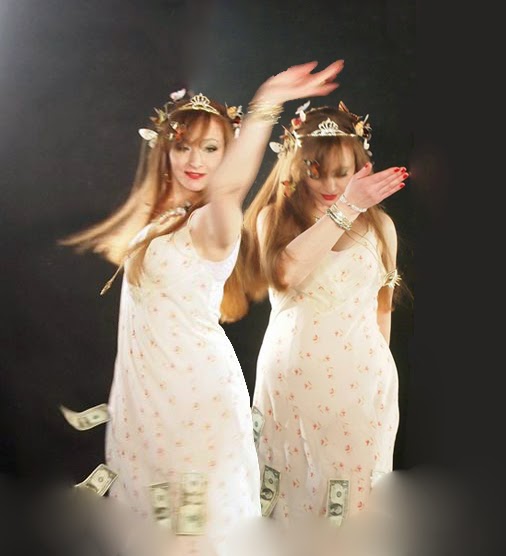
So I guess there's a sweet dream and a nightmare depicted here, right? That seems pretty straightforward, so I'm mostly not bothering with a contextual breakdown on this. Who needs context when there are sparkles? But just in case anyone is wondering...
 |
| Part One: The American Dream |
For Part 1, you're mostly on your own. Except I will throw a bone to the botanically-challenged. Those flowers are poppies. Not that the poppies featured in this video were grown in Afghanistan or used to make opium, or, even worse, heroin. No doubt they were legally cultivated for Oxycontin, or for Armistice Day oops no wait we don't observe that anymore I mean Veterans Day, or just for a lovely floral centerpiece. Also, check out that beautiful engagement ring. I hope she settled for nothing less than DeBeers. You go girl. Shine bright like a diamond.

 |
| Part Two: Lucid |
For Part 2, you might start with the 8-pointed star. Consider that it may be interpreted as a symbol of Ishtar or Venus, as the wheel of the year, or as a symbol of regeneration. Or consider it as a symbol of chaos magic. As a side exploration, belly dance enthusiasts (possibly depending on whether or not they consider the dance in this clip to be "belly dance") may from there find it rewarding to ponder chaos as it is understood as "fitna."
 |
| Ewww! Look at all of those slimy elemental creepy crawlies. They are freaking me out. But look at how they sparkle. But, I don't know, that pretty girl looks a little scary. This is weird. I am confused. |
 |
| Other than people making cryptic videos, are other adults buying multicolor rhinestone frog and sparkle crustacean bracelets? The existence of said items leads me to believe that there are other events and venues appropriate to such baubles. How do I more fully insinuate myself into the invertebrate bling lifestyle? Wait a minute, is this part of Part One? |
Bad bellydancer. Bad. Bad. Bad. Are we in part one or in part two? What are we loathing again? Am I awake? I am so confused.
Let's just admire some pictures.




Monday, January 26, 2015
Does Fitness Cross-Training Make Better Belly Dancers? Sometimes. Maybe.
My segment in the video below kicks off at 4:16. (Link to the full series of interviews.) Watch, or keep reading for an expanded treatment of this same topic.
Like many creative people, I have a personality that encompasses seeming contradictions. For instance, although I've dedicated the better part of my life to exploring the physicality of dance expression, I am a low-energy person. I sometimes have trouble finding the energy to dance, and I essentially always have trouble motivating myself to exercise. To be honest, I find workouts to be something of an ordeal.
Experts often say that if you do not enjoy exercise then you simply are doing the wrong kind of exercise. This seems credible to me, so at one point I thought that maybe I just didn't know enough about different modes of fitness. Maybe, I thought, if I understood exercise better, I would learn to appreciate it or find some way to make it work better for me personally. Thus in 2009 I obtained AFAA group fitness certification, earned a diploma from a 300-hour vocational preparation program for personal trainers, frittered away far too much money trying each and every one of New York City's fitness trends (aqua yogalates barre boxing spin fusion, anyone?), and even briefly worked as a trainer in a health club. Turns out that, at least in my case, experts are wrong. I know now a LOT about exercise, I truly tried it all, and I still find it to be, at best, a chore.
But the silver lining is that I am often able to put my knowledge of fitness practices to good use helping others, particularly dancers.
So, will fitness cross-training make you a better dancer? What kind of conditioning program do I recommend? Unfortunately, as with so many things, there are no one-size-fits-all answers.
You do need a reasonable fitness level to perform, at least in a professional capacity, and the more fit you are, the more artistic options are available to you. And if you are a professional entertainer, cross-training can be a useful to tool for achieving and maintaining the slim figure that is required for many jobs in the commercial arena.
For dancers who are more involved with belly dance as recreation, or for dancers who are primarily involved with belly dance as a fitness activity in and of itself, cross-training can be beneficial but is certainly not a requirement. While being more fit opens up more options, one of the most appealing features of belly dance is its adaptability to dancers at differing levels of physical ability. Not every dancer needs to do floorwork or to coruscate indefinitely through a breakneck karshilama. Many dancers, including myself, cherish belly dance in its aspects of social dance and folklore, people's dances that are accessible to anyone and everyone. I am saddened every time I hear a potential student say she thinks she is not in good enough shape to try out a beginner class. At an entry level, belly dance truly has no fitness prerequisite.
And perhaps more importantly, all the fitness in the world won't make up for a lack of dance skill. Star quality depends not only technique, but on musicality, expression and stage presence, and, in the case of cultural styles, contextually appropriate styling. Both strength and flexibility improve a dancer's versatility, but, to my mind, highly-developed coordination and body awareness are far more important for the clean, clear, fluid qualities of movement that primarily distinguish virtuoso belly dance technique. Beyond a baseline level, training large skeletal muscles seems generally less helpful to most belly dancers than the careful cultivation of nuanced articulations—a process that is usually best supported in dance class rather than a gym.
That said, if dance classes alone are not giving you the level of fitness you desire, or if you have the time, energy and financial resources to train outside of dance class, cross-train away. When used as a tool to unlock your body’s potential, cross-training can deepen the authenticity of your physical presence in your dancing, give you a greater sense of owning your movement vocabulary, and strengthen the artistic signature of your work.
When putting together your workout, my best advice is to do a little of what you dislike the most, for utility and maintenance, and a lot of what you like the best, focusing on those activities not as exertions, but as tools to discover and cultivate your unique physical aptitudes.
Whatever it is you dislike, because it is often neglected, is almost always the thing your body needs most urgently, and the thing from which you will gain the most immediate benefit. For women in particular, the dreaded exercise is often heavy lifting; men often find excuses to avoid stretching. Core work is another frequent nominee in everyone's most-detested category. Whatever that thing is for you, a little of it is likely to take you a long way.
Once the chores are taken care of, revel in whatever things your body likes best. (Or, if that’s not happening, whatever things it tolerates least begrudgingly.) Find the activities that are “easy,” and see where they will take you. In my case, I’ve focused cross-training on developing my natural flexibility, and a result, I’ve crafted an exceptionally limber body that imparts my dancing with signature fluidity. But had I instead been naturally good at strength training or cardio, I am sure developing those facilities would have taken my dancing in an equally interesting different direction.
Moving on: I have suggestions to share about various modalities.
Strength-Building at the Gym
Many of the iron-pumping exercises in common use in mainstream gyms were popularized by bodybuilders, and may be better for bodybuilding than for building functional strength. This doesn’t mean that women who do these exercises are likely to become bulky, or that these exercises won't burn calories, just that one-muscle-at-a-time isolations are seldom the most efficient way to train for for real-world activities. I recommend that unless you are bodybuilding, remediating, or working on a rehabilitative goal, you choose bodyweight exercises that engage your full form over machines or exercises that leverage a bracing posture. For instance, choose pushups over bench presses; choose squats over machine leg presses; choose pull-ups over bicep curls. When you have a choice between performing an exercise on a Nautilus-type machine or with free weights, go with the free weights.
Ladies: you make me bonkers when I hear you say, “ew, I don’t want to lift weights because then I’ll get masculine bulging muscles.” NO YOU WON’T. Or, at least, not unless you make it the central focus of your life and work fiendishly for that goal. And even then, if you were to reach that elusive state and didn’t like it, guess what? You could stop or change up your program, and the muscles would quickly melt away. Problem solved. Not only is this “I don’t want muscles” rhetoric nonsense—bulking up is very difficult for women—it’s damaging to you, your mother, your sisters, and your daughters. Don’t perpetuate the idea that strength shouldn’t be cultivated by women because it will somehow make them look ugly. Stop stop stop.
Also, if you’re going to do anything in a gym (and maybe even if you are not), buy this book: A Woman's Book of Strength. Author Karen Andes does a wonderful job of explaining ideal form, and, more exceptionally, writes beautifully about weight lifting as a mind-body discipline and as an expression of femininity. Really, this book is SO GOOD. Buy it.
CrossFit, Kettlebells, Calisthenics, Gymnastics, Agility Training, and Whatnot
For dancers in particular, I tend to think these types of workouts are likely to yield more useful results that more traditional "gym" types of activities. However, these workouts are most accessible to individuals who come to these activities with a baseline level of fitness already in place. If you are inclined to explore in this direction, be proactive about injury prevention, and, ladies, don’t get psyched out by the macho berserker culture that is somewhat attached to this fitness genre. As much as your finances allow, work with a coach or trainer who can ensure that you are working safely and effectively. For inspiration, please check out the amazing CoachTara
Yoga
For those for whom yoga works, yoga works beautifully. But, hard as it is to believe in these yoga-saturated times, yoga is not for everyone. (Or, at least, not every form of yoga is for everyone. In the context of this discussion, I’m speaking about physical practices of yoga that one might undertake as part of a conditioning program.) One consideration that I seldom hear discussed is how body weight and body weight distribution affect yoga practice. I have observed that, in the belly dance community, the most enthusiastic proponents of yoga conditioning tend to be slim, with bodies that are relatively broad-shouldered and narrow-hipped. And, in my own body, I’ve noticed how even small amounts of lost weight can transform postures with which I had struggled in to something relatively easy and pleasant, and free up previously-inaccessible ranges of motion. (Eagle pose, for instance, is just not mechanically ideal for non-willowy legs such as mine.) So, especially for those with a voluptuously low center of gravity, if yoga is a struggle, the moves in your practice may simply be a bad match for finding your movement potential.
Another consideration of yoga cross-training is energetic. At least for Oriental styles, belly dance tends to be energetically contained and curvilinear in its geometry. Most yoga radiates outward in straight lines. This dichotomy isn’t necessarily problematic, but I would encourage dancers to be thoughtful about if and how they wish to incorporate the energy and lines of yoga in to belly dance, and to not engrave into muscle memory shapes that one does not desire in one’s dance.
Probably everyone already knows this already, but there are a lot of very high quality yoga classes that can be streamed over the internet. These might not be a great resource for beginners (as with exercises in the CrossFit, etc category above, injury prevention and and ideal form are much more likely to be realized with good coaching), but are an economical and convenient option for those qualified to work independently. I periodically take classes through YogaGlo. I also like the instructors and beautiful outdoor filming at YogaToday.
Pilates and “Boutique” Fitness
Pilates is yet another modality that works for those for whom it works. I am not one of them. When I was much younger, this was a source of vague uneasiness for me. Before small-p pilates came into the public domain, it was a somewhat obscure modality practiced primarily by dancers, many of whom believed it to be an essential tool in crafting a dancer’s body. In my eagerness to cross every t and dot every i, I did my best to cultivate a Pilates practice, but could not find modifications that would work for my low back. (I have some structural asymmetry in my pelvis and an unstable sacrum, which sounds like something Pilates should be good for, but in my case it is not.) I currently do not practice pilates in any form. Older and wiser, I now have no doubts that I possess the body of a dancer, and an absence of pilates has been immaterial. But, that said, if you like it and it works for you, do it!
Those seeking an alternative or complement to Pilates might be interested in Gyrotonic. Gyrotonic apparata are somewhat similar to those used in Pilates, but the curvilinear paths of Gyrotonic may be a better complement to the air design of belly dance.
In New York City, fitness-seekers may also be interested in Shen Tao. This studio uses unique proprietary apparata, and the director is exceptionally sensitive to creating custom programs that meet individual needs.
Finally, well-bankrolled dancers in NYC and other affluent urban centers might enjoy classes in one of the many the Lotte Berk-derived barre programs. From an exercise perspective, I like the format and flow of this style pretty well, but the high-life packaging is a bit much for my sensibilities. Once I took a class at Physique 57, and between movement cues the extremely upbeat extremely blonde instructor attempted to motivate us by telling us that after class we would all fit into new skinny jeans, and we would have a field trip to the "Jeans Bar at Barney’s." Then, in time with the music, clapping along on the beat, she chanted, "JEANS BAR AT BARNEY’S! JEANS BAR AT BARNEY’S." Yes, this really happened.
Cardio
This is usually a pretty easy one; most everyone has a heart-rate elevating activity that they find to be at least tolerable, or can at least motivate themselves to get up and go for a walk. Personally, I am an unapologetic fan of step aerobics, although there’s not currently one in my regularly scheduled activities. When I lived in Washington, DC, I used to Jazzercise, although I think a lot of what I liked about that program were things I liked about my specific instructor, Pretha Mitchell. (The web says she’s still teaching. If you are looking for a fun workout in DC, this might be it.)
Most of my current cardio happens on an elliptical machine, which, honestly, I really don’t like very well, but once I get myself to the gym I listen to something in my headphones and it’s over with quickly. I concentrate on how improved circulation is keeping my skin beautiful and my blood vessels healthy. I also remind myself about how much I value maintaining the ability to run away from danger, or to run to the assistance of someone in need of aid.
I used to run outside sometimes, but essentially quit after one too many episodes of street harassment. (Sorry team. Jerks: 1, Me: 0. The words bounce off but I’ve been grabbed a few times, and that has been enough to make me concede defeat.) But I do enthusiastically recommend running for those for whom it’s an option. If running is even vaguely appealing to you, go find a copy of the fascinating and inspiring Born to Run (there's probably one at your library), and see if reading this book doesn't charge you up.
Flexibility / Mobility
In this arena perhaps more than any other, different things work for different people. I have done very well with long static stretches. In DC, I benefitted enormously from classes with Lucy Bowen McCauley. If you are outside of DC, the next best thing is probably yin yoga.
Other approaches that I have seen work well for people are Active-Isolated, Kelly Starrett’s Mobility WOD, Intu-flo, and Ki-Hara Resistance Stretching. The story of swimmer Dara Torres’ work with Ki-Hara is especially interesting.
Sometimes massage also makes a big difference. I see a therapist as often as I can afford to, which unfortunately is pretty much never. But I do have a close relationship with my foam roller, and with a blue acrylic dolphin-shaped thingy that’s designed to dig into trigger spots. I also recommend MELT classes.
Finally, I am no way qualified to make any recommendations about nutritional supplements, so I'm not making any, other than to say if you have mobility issues that might be related to adhesions or internal scarring, read up on serrapeptase.
Coordination
I get more than enough of this in the context of my dance activities, so I haven’t made much of a study of coordination programs in the fitness world, but I have always been intrigued by this program: Andrey Lappa's Dance of Shiva.
Somatic Education
Established dancers are unlikely to need much work in this area, but taking ownership of efficient movement patterns is a huge factor in day to day good health. If you suffer from chronic pain, are injury prone, have postural problems or acquired asymmetries, or struggle to move with grace, the act of putting new intentionality into your movement patterns may have significant fitness benefits. If this is you, look at Feldenkrais, Alexander Technique, and Aligned and Well. In New York City there are a gazillion resources specific to this sort of work, but some of those that I know better and recommend are Somatic Anatomy (one half of whom is a belly dancer), The Breathing Project, Embodied Asana, and Irene Dowd, who can be hard to track down, but seems to currently be at Noho Pilates.
So, armed with all of this knowledge, what is my actual workout, and will it work for you?
Your mileage may vary. Having gone through the strange, long, dark tunnel of trying to become an “exercise person” only to come out and find myself exactly where I started, I have reverted to the bare-minimum fitness routine I need to stay in good health. I do 20ish minutes of some kind of cardio a few times a week followed by maintenance stretching, bodyweight squats in the kitchen while I wait for the kettle to boil, and a pushup or two when I need to take a get-away-from-the-computer break. I kick up into a handstand (balancing with feet against the wall) a few times a week, based on an intuitive feeling that I benefit from occasional inversion. Once in a while I'll do an online yoga class. When I don't have much going on I try to throw in a little more resistance training, either with weights or just doing body weight exercises. And, being a New York City resident, I have a good amount of walking and stair-climbing built into my everyday routine. I regard good posture and optimal biomechanics as my birthright, and attend to their maintenance as a sacred duty. I am barefoot whenever possible, and in utterly flat shoes when it is not, with occasional exceptions made for hot dates. That's pretty much it.
Like many creative people, I have a personality that encompasses seeming contradictions. For instance, although I've dedicated the better part of my life to exploring the physicality of dance expression, I am a low-energy person. I sometimes have trouble finding the energy to dance, and I essentially always have trouble motivating myself to exercise. To be honest, I find workouts to be something of an ordeal.
Experts often say that if you do not enjoy exercise then you simply are doing the wrong kind of exercise. This seems credible to me, so at one point I thought that maybe I just didn't know enough about different modes of fitness. Maybe, I thought, if I understood exercise better, I would learn to appreciate it or find some way to make it work better for me personally. Thus in 2009 I obtained AFAA group fitness certification, earned a diploma from a 300-hour vocational preparation program for personal trainers, frittered away far too much money trying each and every one of New York City's fitness trends (aqua yogalates barre boxing spin fusion, anyone?), and even briefly worked as a trainer in a health club. Turns out that, at least in my case, experts are wrong. I know now a LOT about exercise, I truly tried it all, and I still find it to be, at best, a chore.
But the silver lining is that I am often able to put my knowledge of fitness practices to good use helping others, particularly dancers.
So, will fitness cross-training make you a better dancer? What kind of conditioning program do I recommend? Unfortunately, as with so many things, there are no one-size-fits-all answers.
You do need a reasonable fitness level to perform, at least in a professional capacity, and the more fit you are, the more artistic options are available to you. And if you are a professional entertainer, cross-training can be a useful to tool for achieving and maintaining the slim figure that is required for many jobs in the commercial arena.
For dancers who are more involved with belly dance as recreation, or for dancers who are primarily involved with belly dance as a fitness activity in and of itself, cross-training can be beneficial but is certainly not a requirement. While being more fit opens up more options, one of the most appealing features of belly dance is its adaptability to dancers at differing levels of physical ability. Not every dancer needs to do floorwork or to coruscate indefinitely through a breakneck karshilama. Many dancers, including myself, cherish belly dance in its aspects of social dance and folklore, people's dances that are accessible to anyone and everyone. I am saddened every time I hear a potential student say she thinks she is not in good enough shape to try out a beginner class. At an entry level, belly dance truly has no fitness prerequisite.
And perhaps more importantly, all the fitness in the world won't make up for a lack of dance skill. Star quality depends not only technique, but on musicality, expression and stage presence, and, in the case of cultural styles, contextually appropriate styling. Both strength and flexibility improve a dancer's versatility, but, to my mind, highly-developed coordination and body awareness are far more important for the clean, clear, fluid qualities of movement that primarily distinguish virtuoso belly dance technique. Beyond a baseline level, training large skeletal muscles seems generally less helpful to most belly dancers than the careful cultivation of nuanced articulations—a process that is usually best supported in dance class rather than a gym.
That said, if dance classes alone are not giving you the level of fitness you desire, or if you have the time, energy and financial resources to train outside of dance class, cross-train away. When used as a tool to unlock your body’s potential, cross-training can deepen the authenticity of your physical presence in your dancing, give you a greater sense of owning your movement vocabulary, and strengthen the artistic signature of your work.
When putting together your workout, my best advice is to do a little of what you dislike the most, for utility and maintenance, and a lot of what you like the best, focusing on those activities not as exertions, but as tools to discover and cultivate your unique physical aptitudes.
Whatever it is you dislike, because it is often neglected, is almost always the thing your body needs most urgently, and the thing from which you will gain the most immediate benefit. For women in particular, the dreaded exercise is often heavy lifting; men often find excuses to avoid stretching. Core work is another frequent nominee in everyone's most-detested category. Whatever that thing is for you, a little of it is likely to take you a long way.
Once the chores are taken care of, revel in whatever things your body likes best. (Or, if that’s not happening, whatever things it tolerates least begrudgingly.) Find the activities that are “easy,” and see where they will take you. In my case, I’ve focused cross-training on developing my natural flexibility, and a result, I’ve crafted an exceptionally limber body that imparts my dancing with signature fluidity. But had I instead been naturally good at strength training or cardio, I am sure developing those facilities would have taken my dancing in an equally interesting different direction.
Moving on: I have suggestions to share about various modalities.
Strength-Building at the Gym
Many of the iron-pumping exercises in common use in mainstream gyms were popularized by bodybuilders, and may be better for bodybuilding than for building functional strength. This doesn’t mean that women who do these exercises are likely to become bulky, or that these exercises won't burn calories, just that one-muscle-at-a-time isolations are seldom the most efficient way to train for for real-world activities. I recommend that unless you are bodybuilding, remediating, or working on a rehabilitative goal, you choose bodyweight exercises that engage your full form over machines or exercises that leverage a bracing posture. For instance, choose pushups over bench presses; choose squats over machine leg presses; choose pull-ups over bicep curls. When you have a choice between performing an exercise on a Nautilus-type machine or with free weights, go with the free weights.
Ladies: you make me bonkers when I hear you say, “ew, I don’t want to lift weights because then I’ll get masculine bulging muscles.” NO YOU WON’T. Or, at least, not unless you make it the central focus of your life and work fiendishly for that goal. And even then, if you were to reach that elusive state and didn’t like it, guess what? You could stop or change up your program, and the muscles would quickly melt away. Problem solved. Not only is this “I don’t want muscles” rhetoric nonsense—bulking up is very difficult for women—it’s damaging to you, your mother, your sisters, and your daughters. Don’t perpetuate the idea that strength shouldn’t be cultivated by women because it will somehow make them look ugly. Stop stop stop.
Also, if you’re going to do anything in a gym (and maybe even if you are not), buy this book: A Woman's Book of Strength. Author Karen Andes does a wonderful job of explaining ideal form, and, more exceptionally, writes beautifully about weight lifting as a mind-body discipline and as an expression of femininity. Really, this book is SO GOOD. Buy it.
CrossFit, Kettlebells, Calisthenics, Gymnastics, Agility Training, and Whatnot
For dancers in particular, I tend to think these types of workouts are likely to yield more useful results that more traditional "gym" types of activities. However, these workouts are most accessible to individuals who come to these activities with a baseline level of fitness already in place. If you are inclined to explore in this direction, be proactive about injury prevention, and, ladies, don’t get psyched out by the macho berserker culture that is somewhat attached to this fitness genre. As much as your finances allow, work with a coach or trainer who can ensure that you are working safely and effectively. For inspiration, please check out the amazing CoachTara
Yoga
For those for whom yoga works, yoga works beautifully. But, hard as it is to believe in these yoga-saturated times, yoga is not for everyone. (Or, at least, not every form of yoga is for everyone. In the context of this discussion, I’m speaking about physical practices of yoga that one might undertake as part of a conditioning program.) One consideration that I seldom hear discussed is how body weight and body weight distribution affect yoga practice. I have observed that, in the belly dance community, the most enthusiastic proponents of yoga conditioning tend to be slim, with bodies that are relatively broad-shouldered and narrow-hipped. And, in my own body, I’ve noticed how even small amounts of lost weight can transform postures with which I had struggled in to something relatively easy and pleasant, and free up previously-inaccessible ranges of motion. (Eagle pose, for instance, is just not mechanically ideal for non-willowy legs such as mine.) So, especially for those with a voluptuously low center of gravity, if yoga is a struggle, the moves in your practice may simply be a bad match for finding your movement potential.
Another consideration of yoga cross-training is energetic. At least for Oriental styles, belly dance tends to be energetically contained and curvilinear in its geometry. Most yoga radiates outward in straight lines. This dichotomy isn’t necessarily problematic, but I would encourage dancers to be thoughtful about if and how they wish to incorporate the energy and lines of yoga in to belly dance, and to not engrave into muscle memory shapes that one does not desire in one’s dance.
Probably everyone already knows this already, but there are a lot of very high quality yoga classes that can be streamed over the internet. These might not be a great resource for beginners (as with exercises in the CrossFit, etc category above, injury prevention and and ideal form are much more likely to be realized with good coaching), but are an economical and convenient option for those qualified to work independently. I periodically take classes through YogaGlo. I also like the instructors and beautiful outdoor filming at YogaToday.
Pilates and “Boutique” Fitness
Pilates is yet another modality that works for those for whom it works. I am not one of them. When I was much younger, this was a source of vague uneasiness for me. Before small-p pilates came into the public domain, it was a somewhat obscure modality practiced primarily by dancers, many of whom believed it to be an essential tool in crafting a dancer’s body. In my eagerness to cross every t and dot every i, I did my best to cultivate a Pilates practice, but could not find modifications that would work for my low back. (I have some structural asymmetry in my pelvis and an unstable sacrum, which sounds like something Pilates should be good for, but in my case it is not.) I currently do not practice pilates in any form. Older and wiser, I now have no doubts that I possess the body of a dancer, and an absence of pilates has been immaterial. But, that said, if you like it and it works for you, do it!
Those seeking an alternative or complement to Pilates might be interested in Gyrotonic. Gyrotonic apparata are somewhat similar to those used in Pilates, but the curvilinear paths of Gyrotonic may be a better complement to the air design of belly dance.
In New York City, fitness-seekers may also be interested in Shen Tao. This studio uses unique proprietary apparata, and the director is exceptionally sensitive to creating custom programs that meet individual needs.
Finally, well-bankrolled dancers in NYC and other affluent urban centers might enjoy classes in one of the many the Lotte Berk-derived barre programs. From an exercise perspective, I like the format and flow of this style pretty well, but the high-life packaging is a bit much for my sensibilities. Once I took a class at Physique 57, and between movement cues the extremely upbeat extremely blonde instructor attempted to motivate us by telling us that after class we would all fit into new skinny jeans, and we would have a field trip to the "Jeans Bar at Barney’s." Then, in time with the music, clapping along on the beat, she chanted, "JEANS BAR AT BARNEY’S! JEANS BAR AT BARNEY’S." Yes, this really happened.
Cardio
This is usually a pretty easy one; most everyone has a heart-rate elevating activity that they find to be at least tolerable, or can at least motivate themselves to get up and go for a walk. Personally, I am an unapologetic fan of step aerobics, although there’s not currently one in my regularly scheduled activities. When I lived in Washington, DC, I used to Jazzercise, although I think a lot of what I liked about that program were things I liked about my specific instructor, Pretha Mitchell. (The web says she’s still teaching. If you are looking for a fun workout in DC, this might be it.)
Most of my current cardio happens on an elliptical machine, which, honestly, I really don’t like very well, but once I get myself to the gym I listen to something in my headphones and it’s over with quickly. I concentrate on how improved circulation is keeping my skin beautiful and my blood vessels healthy. I also remind myself about how much I value maintaining the ability to run away from danger, or to run to the assistance of someone in need of aid.
I used to run outside sometimes, but essentially quit after one too many episodes of street harassment. (Sorry team. Jerks: 1, Me: 0. The words bounce off but I’ve been grabbed a few times, and that has been enough to make me concede defeat.) But I do enthusiastically recommend running for those for whom it’s an option. If running is even vaguely appealing to you, go find a copy of the fascinating and inspiring Born to Run (there's probably one at your library), and see if reading this book doesn't charge you up.
Flexibility / Mobility
In this arena perhaps more than any other, different things work for different people. I have done very well with long static stretches. In DC, I benefitted enormously from classes with Lucy Bowen McCauley. If you are outside of DC, the next best thing is probably yin yoga.
Other approaches that I have seen work well for people are Active-Isolated, Kelly Starrett’s Mobility WOD, Intu-flo, and Ki-Hara Resistance Stretching. The story of swimmer Dara Torres’ work with Ki-Hara is especially interesting.
Sometimes massage also makes a big difference. I see a therapist as often as I can afford to, which unfortunately is pretty much never. But I do have a close relationship with my foam roller, and with a blue acrylic dolphin-shaped thingy that’s designed to dig into trigger spots. I also recommend MELT classes.
Finally, I am no way qualified to make any recommendations about nutritional supplements, so I'm not making any, other than to say if you have mobility issues that might be related to adhesions or internal scarring, read up on serrapeptase.
Coordination
I get more than enough of this in the context of my dance activities, so I haven’t made much of a study of coordination programs in the fitness world, but I have always been intrigued by this program: Andrey Lappa's Dance of Shiva.
Somatic Education
Established dancers are unlikely to need much work in this area, but taking ownership of efficient movement patterns is a huge factor in day to day good health. If you suffer from chronic pain, are injury prone, have postural problems or acquired asymmetries, or struggle to move with grace, the act of putting new intentionality into your movement patterns may have significant fitness benefits. If this is you, look at Feldenkrais, Alexander Technique, and Aligned and Well. In New York City there are a gazillion resources specific to this sort of work, but some of those that I know better and recommend are Somatic Anatomy (one half of whom is a belly dancer), The Breathing Project, Embodied Asana, and Irene Dowd, who can be hard to track down, but seems to currently be at Noho Pilates.
So, armed with all of this knowledge, what is my actual workout, and will it work for you?
Your mileage may vary. Having gone through the strange, long, dark tunnel of trying to become an “exercise person” only to come out and find myself exactly where I started, I have reverted to the bare-minimum fitness routine I need to stay in good health. I do 20ish minutes of some kind of cardio a few times a week followed by maintenance stretching, bodyweight squats in the kitchen while I wait for the kettle to boil, and a pushup or two when I need to take a get-away-from-the-computer break. I kick up into a handstand (balancing with feet against the wall) a few times a week, based on an intuitive feeling that I benefit from occasional inversion. Once in a while I'll do an online yoga class. When I don't have much going on I try to throw in a little more resistance training, either with weights or just doing body weight exercises. And, being a New York City resident, I have a good amount of walking and stair-climbing built into my everyday routine. I regard good posture and optimal biomechanics as my birthright, and attend to their maintenance as a sacred duty. I am barefoot whenever possible, and in utterly flat shoes when it is not, with occasional exceptions made for hot dates. That's pretty much it.
Friday, September 19, 2014
The Value of "Professional" Choreography
When I choreograph
Oriental dance, I generally approach my work as a music
visualization, structuring my composition to reproduce the
architecture of its accompanying music. Since most traditional Oriental dance music makes use of repetition with
variation and of nested call-and-response phrasing, my choreographies
tend to take this same form. I typically show musical recapitulations
with movement phrases danced first on side, then danced in a mirrored
version on the other side.
 |
| I am a fan of balanced composition. |
Some dancers may
be surprised that an accomplished artist uses symmetrical combinations. At the time I am writing, September of 2014, it is not
unusual to encounter the sentiment that it is “more professional”
to construct choreographies so that they make no use of repetition,
regardless of repetition in the accompanying music. Inspired largely
by competition aesthetics, but also by influences from the greater
consumer culture, many dancers aspire to switch up to a brand new
combo at the start of every musical phrase, and do not use the
structure of their music to inform the structure of their dance.
To me,
traditional-context belly dance choreography that places asymmetrical
movement phrases on call-and-response music seems superficial and
clumsy, no matter how sophisticated the individual movements or how
beautiful the technique with which they are danced. I perfectly
understand free-form movement when a dancer is following the meanders
of a taxim. I also understand free-form movement, even to structured
music, in the context of improvised dance, when a dancer shares her
exploration of music with an audience in real time. But to me, the
whole point of choreography is not to simulate improvisation, but to show the results of
already-completed creative exploration. I create choreography to take
advantage of the additional possibilities an artist unlocks when she
prepares, with care, in advance.
So, when I first
heard free-form choreography described as “more professional” I
was bewildered, and, honestly, dismayed by what I perceived as a
slight to both my own aesthetic and to common sense. How had my
colleagues become so enthusiastic about dances that use music as
nothing more than an atmospheric metronome?
After some
reflection, though, I've now come to agree that free-form
choreography is indeed the professional's hallmark. I don't mean that
my tastes have changed; rather I've thought a little more deeply
about the terminology. The pro dancer, the wage worker who depends on
entertaining merry-makers and pleasing an employer, absolutely
demonstrates professionalism when she continually switches things up.
Having worked in
restaurants and nightclubs, I know firsthand that a relentless
barrage of novelty has the greatest appeal to the short attention
span of a typical contemporary audience in a commercial context.
(Wings! Next I'll balance a tray! How about some audience
participation? Everybody dance! And let's have some veil poi! You've
seen cane, but have you seen flaming cane? On roller skates?) I would
like to think that Middle Eastern audiences, who in theory have a
greater connection to Middle Eastern music and have historically
embraced a more subtle aesthetic, would be less receptive to
novelty-based choreography. But some of the most haphazard-looking
sequencing that I've seen recently has come straight from Egypt, and
many of today's most-admired Egyptian-style stars construct dances
around accents, spins, spine-whipping body waves, and ceaseless
shimmies, paying minimal attention to melody instruments. In the world
of Tribal Fusion, too, there's a marked increase in frenetic
showboating. With this in mind, a planned and polished atmosphere
blast may indeed be the most reliable way to win the acclaim of the undiscriminating masses and secure paying work.
But our dance
deserves to be valued for more than the wage a dancer earns. With the
greatest admiration and respect for those who succeed at the absurdly
difficult task of earning a living through belly dance, I encourage
dancers not to lose sight of other approaches and other perspectives.
Our community has a tendency to assign the highest value to that
which it considers “authentic,” so some may choose to arbitrarily
adopt Egyptian, Turkish, or other culturally-conventional aesthetics.
We also reward dance which is “professional,” too often
forgetting that image, personality, networking, and business savvy
strongly affect a dancer's success in the marketplace. But just
because a dance is authentic and professional does not mean it is an
artistic success.
Good dance can
come in all kinds of packages. The mainstream of belly dance is the
popular expression of our medium, something like what top-40 pop is to
music. I don't
mean to imply that all popular entertainment is necessarily
superficial formulaic fluff, only that, like music, fiction, movies,
and other creative arts, belly dance can shine in folk, commercial, and "high" art expressions. The popularity of mass-market paperbacks
doesn't diminish the value of literature. Or, to those who enjoy it,
of fan-fiction published in internet forums. The popular embrace of
slickness and novelty simply should not constrain the aesthetic of every
dance. Our “niche” products—folklore; fakelore; historic and
vintage styles from bygone eras; various permutations of “tribal”
dance with attendant acronyms; Goddess invocations; conceptual work
in and beyond fantasy, gothic, and steampunk contextual transpositions; my own idiom of
“exquisitely crafted belly dance theater”—do not each speak to
everyone, but they are cherished by their devotees, and they are the
creative wellspring on which the commercial sphere depends. An
artist is not diminished if her work speaks only to a select
audience.
I value work that
shows deftness, sensitivity, and heart. I appreciate creativity,
refinement, and rigor. I feel most proud of my most self-expressive
work, and I generally prefer to see and study with artists who
similarly invest their dances with their own distinctive signature. I
value “authenticity,” but to me this means an attraction to
artistic honesty rather than an indiscriminate embrace of Egyptian
trends.
But to each her
own. The Extreme Dance Blast has its fans. And even if it isn't my
cup of tea I do appreciate the technical skill of its presenters. I
wish more of my colleagues had this perspective. I feel like most of
those who, like me, are left flat by haphazard sequencing want to
throw the babies of technique and choreography out with the bathwater
of the latest trends. I hear from too many dancers who draw the
incorrect conclusion that choreography, by definition, is a
demonstration of having memorized a laundry list of arbitrarily
assembled movements, and that only artists who improvise have a deep
and meaningful engagement with music. I see an anti-technique
backlash too, led by dancers who seem to not understand that
technique can be cultivated as a tool, not something one might only
pursue as an end unto itself. “Just give me a dancer who does three
moves, but does them well,” they say. “These technique queens are
trying too hard,” they grumble.
As the kids (sort
of) say, don't hate the game, hate the player. Actually, don't hate
the player either. Any given three-move dancer may truly be a
delight, but complex expressions that use complex vocabulary have
equal—or, I believe, greater—potential to charm, to intrigue, to
entertain, to transport. On the flip side, I have abundant, character-building, personal experience with the potential for complex expressions to end in complex catastrophes. We're still
learning our way through this new territory. While some may prefer
to stay metaphorically down on the farm, we, as a community, have
seen Paris. I love the farm and I love visiting the ladies who call
it home, but it's absurd to tell us all that there's no point in
exploring beyond its fences. (Young people and international readers who I just lost: try this.)
Having myself
participated in more than a little grumbling over the flailings of
six-week-wonders who don't try hard enough, I won't malign any
impulse that causes a dancer to try “too hard.” I applaud any
dancer who is trying at all. I want to give particular personal
thanks to those who try hard. In fact, if you are willing to try
hard, I challenge you to try even harder. Watching belly dance grow
and change, I greatly appreciate the highly technical vocabulary and
clean body lines that have blossomed over the past decade, a
development in which I like to think I've played some modest part.
Now, I hope to encourage a parallel evolution, and inspire dancers to
put as much thoughtful refinement into the way moves are sequenced as
many of us now put into the moves themselves. Not every dance needs
to be choreographed, not every choreography needs to aspire to the
level of high art, and not every artistic choreography needs to be a
music visualization, but our skill as choreographers needs to catch
up with the new sophistication of our vocabulary. I am confident
that it will. With risk comes the potential for failure, but ars
longa, vita brevis, and you are not getting any younger. If you fail,
I'll try not to judge, and I'll try to to keep telling everyone else
not to judge you either. On the other hand, you might do something
great, and I want to see it.
Click that ►. You can get it if you really want.
Click that ►. You can get it if you really want.
Subscribe to:
Posts (Atom)